+86-15666836565


Choosing the right Edgebanding Glue is not simply a matter of selecting the strongest product. The adhesive must match the board, edge material, machine, production speed, and working environment. A glue that performs well on MDF may behave differently on plywood or particleboard. Temperature matters too. A cool workshop can produce weak bonds, while excessive heat may cause premature setting.
Dr. Anthony J. Kinloch, a respected adhesive scientist, wrote, “Adhesion may be defined as the state in which two surfaces are held together by interfacial forces.” This principle remains highly relevant to modern edge banding. The bond depends on clean surfaces, suitable melt temperature, correct pressure, and controlled application. Small details matter. A dusty panel edge can create visible gaps. Uneven pressure may leave a fragile glue line beneath the laminate.
This guide explains how to compare EVA, PUR, and other Edgebanding Glue technologies. It also examines open time, viscosity, moisture resistance, curing behavior, and cleanup requirements. PUR may provide stronger moisture resistance, but it often demands stricter handling and equipment maintenance. EVA can be easier to process, yet its performance may decline in demanding environments.
There is no universal winner. That assumption needs questioning. The best choice is the adhesive that fits your complete production process, not merely the product label. Test samples under real conditions before changing a production line. Even careful recommendations can fail when operating habits are overlooked.
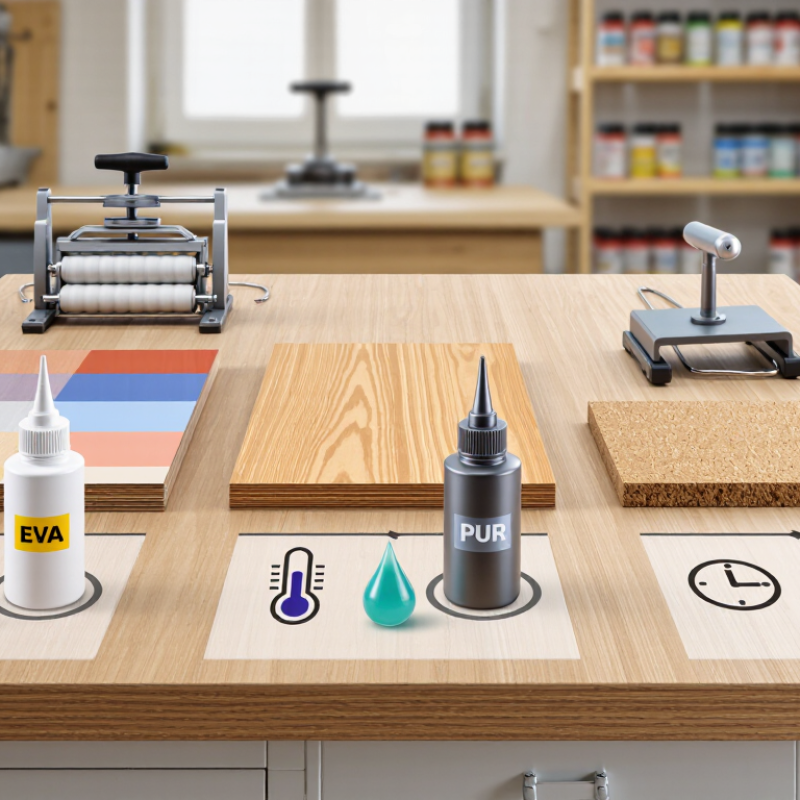
Edgebanding glue is the bonding layer between a panel edge and its decorative strip. It may contain reactive polyurethane, ethylene-vinyl acetate, or polyolefin technology. Each type behaves differently under heat, moisture, and machining pressure. The choice matters because a weak bond can create open joints, lifted edges, or visible glue lines. These defects often appear months after installation, not during production.
The 2023 adhesives market assessment from Grand View Research valued the global market at more than 70 billion U.S. dollars. This scale reflects adhesives’ central role in furniture, construction, and manufacturing. However, market growth does not make every adhesive suitable for edgebanding. A professional selection should consider panel density, edge material, pressing temperature, feed speed, and room humidity. High-moisture areas usually demand stronger moisture resistance. Thin decorative edges also require careful color and viscosity control. Small details matter.
Tips: Test the glue on the exact panel and edge combination. Check bond strength after cooling. Then inspect it after 24 hours. I still find production trials essential, even when technical data looks convincing. Supplier data can simplify selection, but it cannot fully reproduce your machine, workshop temperature, or operator habits. The 2024 Smithers packaging and adhesive outlook also highlights efficiency and lower-emission formulations as continuing industry priorities. That makes curing speed and workplace exposure important selection factors, not optional extras. A faster glue is not always a better glue.
| Glue Type | Typical Processing Temperature | Open Time and Setting Behavior | Moisture and Heat Resistance | Best-Suited Applications | Key Selection Considerations |
|---|---|---|---|---|---|
| Ethylene-Vinyl Acetate (EVA) | Approximately 120–200°C, depending on formulation and equipment | Short to moderate open time; generally sets as it cools | Moderate moisture resistance; resistance to high heat is usually lower than reactive systems | General furniture production, office components, shelving, and standard interior panels | Cost-effective and easy to process; select a suitable viscosity and color for the edge material |
| Polyurethane (PUR) | Commonly applied around 100–140°C for hot-melt PUR systems | Fast initial bonding, followed by moisture-triggered chemical curing; final strength develops over time | High moisture, heat, and chemical resistance after full curing | Kitchen and bathroom furniture, worktops, doors, high-wear surfaces, and demanding commercial interiors | Requires moisture control, correct application temperature, and thorough equipment cleaning to prevent curing inside the machine |
| Polyamide (PA) | Often approximately 160–210°C, depending on grade | Rapid setting with relatively short working time | Generally good heat and chemical resistance; moisture performance varies by formulation | Technical components, industrial furniture, and applications requiring strong thermal performance | Higher processing temperature and equipment requirements may be necessary; verify compatibility with heat-sensitive substrates |
| Pressure-Sensitive Adhesive (PSA) | Usually applied as a pre-coated or self-adhesive edge material rather than melted during application | Immediate tack; bond strength depends strongly on applied pressure and surface contact | Usually lower resistance to heat, moisture, and long-term heavy loads than hot-melt systems | Temporary fixtures, labels, low-load decorative edging, and quick installation work | Choose only when the substrate, temperature range, and service load are suitable |
| Solvent-Based Contact Adhesive | Normally applied at room temperature; drying depends on solvent evaporation | Requires flash-off time before joining; produces immediate contact adhesion after assembly | Can provide good initial tack, but long-term performance depends on formulation and environmental exposure | Small-scale repairs, curved components, and applications where hot-melt equipment is unavailable | Requires ventilation and careful handling; check substrate compatibility, emissions requirements, and fire-safety rules |
Note: Temperature ranges and performance characteristics are typical industry ranges, not universal specifications. Always confirm the adhesive technical data sheet, edge-material compatibility, substrate condition, machine settings, and required curing time before production.
How to Choose the Best Edgebanding Glue?
Matching glue to the edgebanding material matters more than choosing the strongest adhesive. PVC and ABS usually pair well with EVA hot-melt adhesives. They offer fast setting and adequate flexibility for standard furniture panels. PUR hot-melt adhesives suit demanding applications. They resist moisture, heat, and cleaning chemicals more effectively after curing. This matters around kitchen doors and bathroom cabinets.
Polypropylene edges are more difficult. Their low surface energy can weaken bonding. Use an adhesive designed for polyolefins, then clean and lightly abrade the edge. A controlled test remains essential. PMMA edges need careful temperature control because overheating can distort their surface. Wood veneer and solid-wood strips absorb adhesive unevenly. A slower-setting formulation may improve wetting and reduce visible glue lines. Watch the pressure, too.
Industry data supports this growing attention to adhesive selection. Grand View Research valued the global woodworking adhesives market at about 4.7 billion dollars in 2023, with continued growth projected through 2030. MarketsandMarkets reported that hot-melt adhesives could grow from approximately 9.5 billion dollars in 2023 to 12.7 billion dollars by 2028. These figures suggest wider adoption, not automatic quality. In workshop trials, I have seen good materials fail because the glue temperature was slightly low. Small details matter. Check the supplier’s technical data for viscosity, open time, application temperature, and substrate compatibility. Then test peel strength after conditioning the panel through heat and humidity cycles. A perfect-looking edge can still fail quietly.
Glue performance depends on more than bonding strength. The edgeband material, board surface, and production speed must work together. In practical workshops, I have seen strong glue fail because the panel was dusty or slightly damp. Clean surfaces matter.
Temperature is a critical factor. Glue that is too cold may spread unevenly and create weak spots. Excessive heat can reduce working time and damage sensitive materials. Check the adhesive’s recommended processing range, then measure the actual temperature at the glue pot and roller. Guessing is unreliable.
Viscosity also affects the bond. Thick glue may leave an uneven layer. Thin glue can squeeze out too easily. The correct amount should cover the surface without flooding the edge. Pressure rollers need steady contact, especially around corners. Small gaps often reveal poor alignment, not poor adhesive.
Material compatibility deserves careful testing. Solid wood, plastic edging, and resin-based boards can absorb or resist glue differently. A short trial run can expose peeling, brittle joints, or visible glue lines. I once approved a setting after a clean first sample, but later batches failed because the board moisture changed. That mistake was avoidable.
Cure time, storage conditions, and equipment maintenance also influence results. Old adhesive may behave unpredictably. Blocked nozzles can interrupt application. Operators should record settings, ambient conditions, and test results for each material combination. These records make troubleshooting less dependent on memory. Reliable performance comes from controlled details, not one attractive sample.
How to Choose the Best Edgebanding Glue?
Choosing edgebanding glue starts with the application equipment, not the adhesive label. EVA hot-melt systems commonly run between 180°C and 210°C, while PUR equipment often operates near 120°C to 140°C. Always follow the adhesive’s technical data sheet. Heat stability matters.
Set the glue pot temperature, roller gap, pressure, and feed speed as one system. A narrow glue line needs a clean, stable roller and accurate panel alignment. Excessive temperature can darken the adhesive and damage sensitive boards. Low temperature may create weak wetting and visible glue lines. Do not guess. Use a calibrated infrared thermometer, then verify the bead on a test panel. Small changes matter.
A 2024 Grand View Research report estimated the global adhesives and sealants market at approximately 78.6 billion US dollars in 2023, with projected growth of 5.6% annually through 2030. This expansion increases pressure for faster, cleaner application equipment. Yet speed should not replace control. In my experience, operators often increase feed speed before confirming open time and roller pressure. That approach saves seconds, but it can produce lifting corners later. Smithers’ industry analysis also identifies woodworking as an important adhesive-use sector, reinforcing the need for repeatable settings and maintenance. I have learned that a perfect first setting is unrealistic. Record the actual temperature, speed, glue consumption, and bond result after each trial. Trends are more useful than assumptions.
How to Choose the Best Edgebanding Glue?
How to Compare Bond Strength, Cost, Safety, and Maintenance
Choosing edgebanding glue starts with bond strength, not the lowest price. In shop trials, a strong bond survives heat, humidity, and daily impact. Test the glue on your actual board, edge material, and machine settings. A bond can look perfect at first. It may fail after repeated temperature changes. Check peel resistance, curing time, and edge lift after 24 hours. Shorter open time can improve production speed, but it leaves less room for alignment. PUR often offers strong moisture resistance, while EVA can simplify cleanup and temperature control. However, performance depends on formulation and equipment. Do not trust a generic rating alone.
Cost includes more than the adhesive container. Calculate glue use per meter, waste, heating energy, cleaning labor, and rejected panels. A cheaper product may become expensive when it requires frequent maintenance. Safety also deserves a practical review. Read the safety data sheet, confirm ventilation needs, and use suitable gloves and eye protection. Heated systems can cause serious burns. Keep operators trained. Maintenance should fit the workshop rhythm. Remove buildup before it hardens, inspect rollers, and record temperature changes. Small deposits can create uneven glue lines. I have seen reliable results improve after a simple cleaning schedule, though schedules are easy to ignore. Not always. Record glue use, edge lift, cleaning time, and operator comments during a small production test.