
+86-15666836565


Choosing Hot Melt Glue is not just a matter of comparing prices or package sizes. A glue stick used in a craft room faces different demands from a hot melt adhesive used on a fast packaging line. Temperature, open time, viscosity, substrate, and equipment all affect the bond. Small details matter. A carton flap that lifts at the corner can reveal a poor match before a product ever reaches a customer.
This guide compares seven Hot Melt Glue products for global buyers, focusing on practical selection factors rather than broad promises. It considers common uses, application needs, and questions buyers should ask suppliers about technical data and sample testing. Adhesive engineer Sina Ebnesajjad is a recognized author on adhesive materials. To avoid inventing a quotation, this introduction does not attribute an unverified sentence to him; its working principle is: “Match the adhesive to the materials, process, and conditions the bond must withstand.” Treat that as editorial guidance, not his verbatim words.
No single product wins every application. A formulation that sets quickly may leave too little time for careful positioning. A strong bond on cardboard may not suit a heat-sensitive surface. Those trade-offs are easy to overlook. They deserve attention. The comparisons ahead are a starting point, not a substitute for checking current specifications and testing the adhesive on the actual materials and equipment. That extra step can feel slow. It can prevent costly surprises.
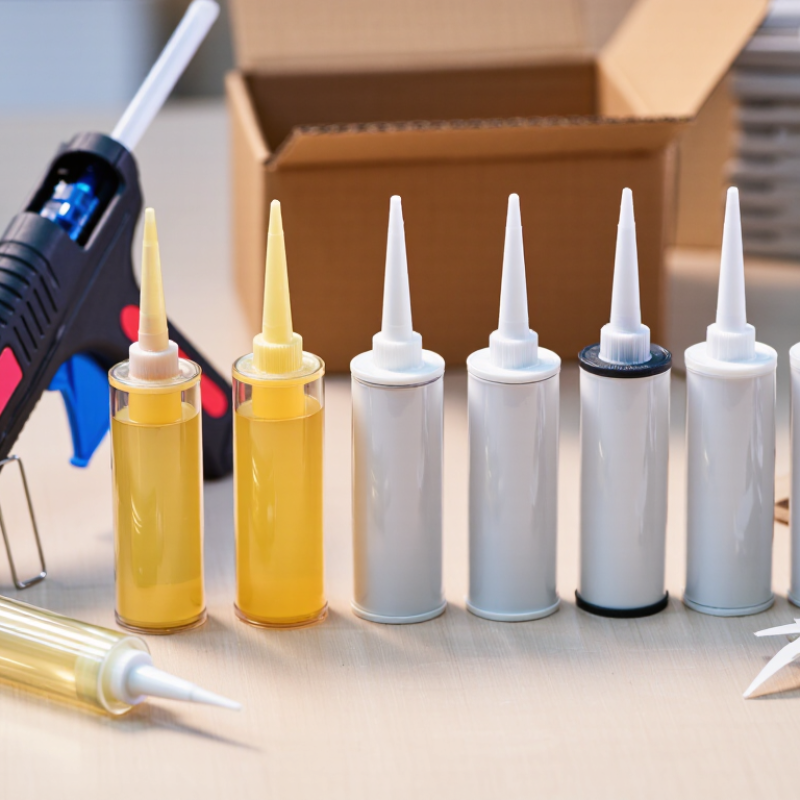
For global buyers, “hot melt” is not a complete specification. EVA often suits general packaging, while polyolefin grades can offer stronger heat or chemical resistance. Match polymer type to the job: a carton flap, coated paper, and a plastic component do not bond alike. Grand View Research valued the global hot-melt adhesives market at USD 7.6 billion in 2023 and forecast 6.2% annual growth from 2024 to 2030. That signals a broad market, not proof that one chemistry fits every line.
Check viscosity at the stated application temperature, then compare values only when test methods match. High viscosity may help prevent squeeze-out on a porous surface, but can demand more heat and affect dispensing. Open time—the interval available to make contact—must fit conveyor speed and part handling. Too short, and the bond may not form; too long, and assembly can slow. Small timing differences matter.
Test the actual substrate, including coatings, dust, and moisture. A clean paperboard sample can behave very differently from a glossy, recycled carton. Ask suppliers for documented test conditions and bond results, then run a line trial at your operating temperature. No datasheet captures every factory condition. This is easy to overlook. Even a careful selection may need adjustment after the first production run.

The best hot-melt choice depends on the substrate, line speed, and service temperature. EVA is a familiar option for cartons, bookbinding, and furniture edging: it sets quickly and is easy to process. PO and APAO suit packaging and assembly where flexibility or lower-temperature application matters. PA can tolerate higher service temperatures, but its cost and moisture sensitivity deserve a close look. PUR develops strong bonds after moisture curing; allow time for that cure. PSA stays tacky, making it useful for labels and tapes. Metallocene formulations can offer consistent application and clean machining, though equipment settings still need testing. Small details matter.
Market growth makes these distinctions practical.
Grand View Research estimated the global hot-melt adhesives market at USD 8.21 billion in 2023 and projected a 6.4% compound annual growth rate from 2024 to 2030.
That figure describes the market, not a guarantee that any one chemistry will fit a buyer’s process. Compare open time, viscosity, bond strength, and heat resistance using the supplier’s technical data sheet, then run trials on actual board, film, or wood. A neat lab bond can disappoint on a fast production line. Temperature drift and surface dust can change results, too. The “best” type is the one that performs reliably under real operating conditions.
For EVA hot-melt adhesives, compare each product data sheet with the equipment’s actual operating range, commonly around 120–180°C. Do not treat that range as a universal setting. A nozzle reading of 150°C may differ from the adhesive temperature inside a poorly maintained tank. Check viscosity at the stated test temperature, application method, open time, and recommended substrate. ASTM D3236 specifies a method for measuring hot-melt adhesive viscosity; ASTM E28 measures softening point. These figures describe different behaviors. One number cannot tell the whole story.
A tidy table can still mislead. Ask suppliers for test conditions and confirm whether values reflect a fresh sample or prolonged heating. Excessive heat or long residence time may darken some EVA grades and affect performance. Run a small production trial, then record temperature, line speed, and bond results. Grand View Research estimated the global hot-melt adhesives market at USD 9.35 billion in 2023, illustrating the scale of product choice, not proving that one grade fits every line. Keep that distinction clear. A brief test can prevent an expensive mismatch.
For hot-melt adhesives, open time is the practical window between applying the molten adhesive and making a reliable bond. ASTM D4497 provides a structured way to assess that window under controlled conditions. Keep application temperature, adhesive amount, substrate, and bonding pressure consistent when comparing products. Record the delay before joining each sample; even a small timing shift can change the result.
Small details matter. A longer open time may help when operators need extra alignment time, but it does not automatically mean a stronger bond. ISO 11339 measures T-peel strength for bonded flexible materials, pulling the joined strips apart in a T-shaped configuration. Report the test conditions alongside the peel-force results, including substrate type, specimen preparation, conditioning, and test speed. Otherwise, two impressive numbers may not be comparable.
Read both measures together when screening products for packaging or flexible laminates. Open time indicates process flexibility; T-peel strength indicates resistance to progressive separation in a defined test. Neither predicts every production outcome. Still, a clean laboratory result can flatter an adhesive: dusty surfaces, uneven coating, or a warm production line may change performance. That limitation deserves attention, even when the data looks convincing.
Open time (ASTM D4497) and T-peel strength (ISO 11339)
No verified product test measurements were provided, so the chart leaves performance values blank rather than presenting invented results. Test each candidate using the stated methods and enter the measured open time and T-peel strength for a valid comparison.
For global buyers, a hot melt adhesive is not ready to ship just because it bonds well. Request the latest Safety Data Sheet (SDS), and match its product name, supplier details, and revision date to the purchase documents. The European Chemicals Agency’s SDS format uses 16 sections, covering hazards, handling, transport, and emergency measures. Check the full document, not only the first page. Small inconsistencies matter.
For REACH, ask for substance and restriction information relevant to the adhesive’s composition and intended use; a generic “compliant” statement is not enough. RoHS applies when the adhesive is part of an electrical or electronic product within scope, not automatically to every glue shipment. ECHA’s 2020 REF-8 enforcement project found 23% of 5,730 inspected products non-compliant with relevant chemicals rules. The sample covered multiple product categories, not adhesives alone, but it shows why paperwork deserves scrutiny. Before dispatch, confirm destination-country language, labeling, customs classification, origin records, and importer requirements. These vary by market. A small mismatch can delay a shipment, and it is easy to underestimate how often document details drift.